


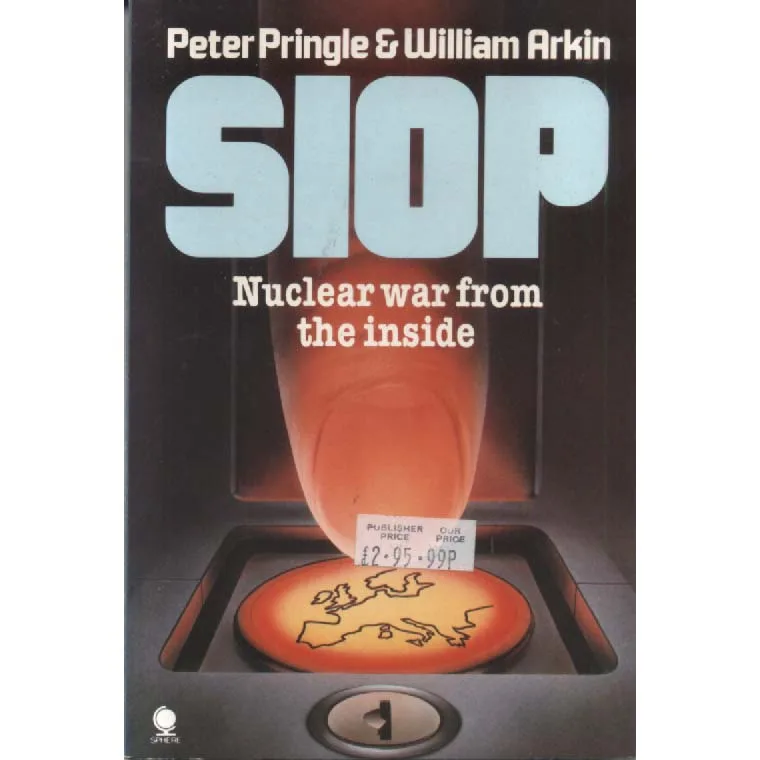
SIOP - Nuclear War From The Inside
Publisher: Sphere
Format: Paperback
ISBN: 9780722170281
SIOP: Nuclear War from the Inside examines the secret American plan for fighting a nuclear war, a phrase that already contains rather more optimism than the subject appears able to support.
SIOP stood for the Single Integrated Operational Plan, the immense and highly classified system intended to coordinate America’s nuclear bombers, land-based missiles and ballistic-missile submarines. “Integrated” was important because the armed services had previously demonstrated an understandable enthusiasm for assigning several nuclear weapons to the same targets. Even during the destruction of civilisation, duplication of effort remained an administrative concern.
Peter Pringle and William Arkin set out to discover how the plan was constructed, who selected its targets, how an attack order would be transmitted and what might happen once the carefully prepared machinery encountered the traditional complications of war: damaged communications, incomplete information, frightened leaders, destroyed headquarters and people making irreversible decisions under impossible pressure.
Using declassified documents and interviews with officials, planners and military personnel, the authors reconstruct a world normally concealed behind acronyms and security clearances. Satellites watch for launches, radar stations scan the horizon, computers assess warnings and underground command posts wait for messages nobody wants to receive. The whole system is enormously sophisticated, except for the minor difficulty that its complete operation could only be tested by using it once.
The book travels inside missile silos, strategic command centres, early-warning stations, nuclear submarines and airborne command posts. Here, crews endure long stretches of routine while remaining prepared to perform an action that would instantly end routine for almost everyone. Their job requires calm professionalism, exact procedure and the ability to accept that the most important moment of their career would also be an exceptionally poor development for the career market generally.
Pringle and Arkin investigate the communications and command network that was supposed to preserve political control during nuclear war. Orders had to reach bombers, submarines and missile crews after cities, telephone exchanges and command centres had begun disappearing. Leaders needed reliable information about enemy attacks while radar and communications systems were under assault. The planners therefore built increasingly elaborate backups, presumably on the principle that if the apocalypse destroys the first three telephones, somebody should still be able to get through on the fourth.
The authors also examine war games in which limited crises escalate through successive military responses. Each decision appears rational when considered alone, yet the sequence ends with Washington destroyed, the president dead and surviving officials ordering massive retaliation from an aircraft. It is bureaucracy’s most alarming achievement: constructing the end of the world through a series of individually defensible meetings.
Particularly troubling is the gap between political language and operational reality. Presidents spoke of flexible options, controlled escalation and limited nuclear exchanges, while the machinery behind them remained designed to unleash attacks of scarcely comprehensible scale. A “limited option” in nuclear planning might still involve enough explosions to make the adjective feel like a public-relations contribution.
Published during the renewed arms race of the Reagan era, the book also considers plans for improved command systems, deeper bunkers and the ability to continue fighting an extended nuclear war. The central assumption was that control could be maintained amid devastation. Pringle and Arkin ask the obvious but institutionally awkward question: maintained by whom, through what equipment and over whatever might remain?
This is not speculative fiction and contains no heroic submarine commander preventing Armageddon with seconds to spare. It is a work of investigative non-fiction about real weapons, real procedures and real people employed to make an unthinkable war technically executable. The irony is that decades of planning intended to make nuclear deterrence credible also made the possibility of actually carrying it out disturbingly organised.
This 1983 Sphere edition runs to 240 pages and remains a fascinating Cold War document. It will appeal to readers interested in nuclear strategy, military command systems, superpower politics and the remarkable human instinct to prepare a detailed filing system for events after which filing systems may no longer be required.
This copy is in Good condition, showing ordinary signs of age and previous reading but remaining structurally sound, complete and considerably more durable than most of the installations discussed inside. Sold by Crappy Old Books, whose own Single Integrated Operational Plan involves wrapping the book, printing the label and hoping Royal Mail does not initiate an uncontrolled escalation.
Keep browsing: See more War books Other books by Peter Pringle and William Arkin
